A GB ENS has up to 37 fields. HMRC's computer reads every one, and it isn't forgiving.
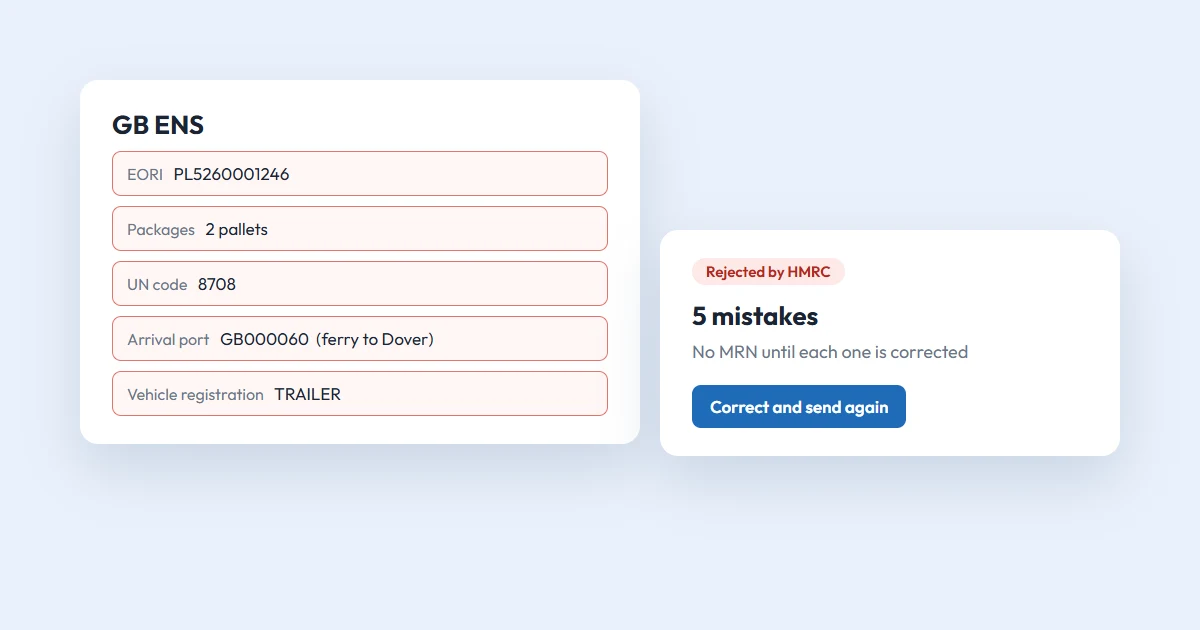
HMRC can turn a declaration down in two ways. Some mistakes are refused the moment you send it: the service answers with a list of error codes and nothing is lodged. Others pass that first check and are rejected a few minutes later, when you get a rejection where the MRN should be. In both cases the result is the same: no MRN, and a lorry that isn't covered.
There's also a third kind of mistake. It gets through, and HMRC writes to you about it afterwards. In February 2026 HMRC published its own list of these, S&S GB – Guidance on common data errors. Two of the five below come straight from it.
1. An EORI that doesn't start with GB
The declaration is lodged under an EORI, and for S&S GB it must be a British one. HMRC's rule 8692 says the EORI of the person lodging "must begin with 'GB'". An EU or XI number in that box is refused on the spot.
This catches hauliers from Poland, Romania or Lithuania filing their first GB ENS. GOV.UK says: "If your business is not established in Great Britain, you'll need an EORI number starting GB."
The other parties have a rule too. If you give a consignor or consignee a GB EORI, the name and address are left out. If you give a non-GB EORI, or none, the name and full address must be filled in.
How to avoid it: get a GB EORI before the first load (it's free on GOV.UK). On ENS Ready, each EORI you type is looked up in the official register, and you're warned if it isn't found.
2. Counting pallets when HMRC wants cartons
The CMR says "2 pallets". The ENS should probably say "50 cartons".
HMRC wants the smallest outer packing unit. Its own example: where cartons sit on a pallet, "the cartons are the 'smallest external packing unit' and therefore the 50 cartons are to be declared".
The package type also decides which boxes may be filled, and getting it wrong is refused straight away:
| Package type | Number of packages | Number of pieces | Marks |
|---|---|---|---|
| Packed (cartons, boxes, drums and so on) | Required | Not allowed | Required |
| Unpacked (codes NE, NF, NG) | Not allowed | Required | |
| Bulk (codes VQ, VG, VL, VY, VR, VS, VO) | Not allowed | Not allowed |
A count of 0 is only allowed when the goods share packaging with another line that has more than 0.
How to avoid it: count what you'd pick up by hand. On ENS Ready you choose the package type from a list, so the code is always a real one.
3. A commodity code in the dangerous goods box
Near the bottom of each goods line is a box for the UN dangerous goods code. It takes the four-digit UN number of a hazardous substance: 1203 is petrol, 1950 is aerosols.
It isn't for the commodity code. That goes in its own box, and it's a different number (4 to 8 digits, from the customs tariff). When a commodity code lands in the UN box, HMRC first accepts the message, then rejects it as an incorrect value. This is the late kind of rejection, and it's easy to miss if you've already moved on to the next job.
How to avoid it: leave the UN box empty unless the load is dangerous goods with ADR paperwork. If it is, the UN number is on that paperwork.
4. Dover's code on a Folkestone crossing
Every GB ENS names the first place the goods arrive, as an 8-character code. Two of them sit next to each other in HMRC's list and get swapped all the time:
- GB000040 is Dover (ferry).
- GB000060 is Folkestone Eurotunnel Freight (Le Shuttle).
HMRC's guidance says: "Codes GB000060 (Folkestone) or GB000040 (Dover) in particular are often being used incorrectly."
The mode of transport goes with it. A lorry and driver on a ferry is mode 10. An unaccompanied trailer on a ferry is 11. A lorry on Le Shuttle is 3, and HMRC adds that with mode 3 "the only CoFE code that can be used is GB000060".
A few others worth having to hand: Holyhead GB000124, Harwich GB000052, Hull GB000072, Immingham GB000074, Portsmouth GB000292, Newhaven GB003250. Our guide to GB ENS location codes has more.
How to avoid it: on ENS Ready you pick the arrival port by name and we send the code.
5. The trailer number where the lorry's registration belongs
For a lorry travelling with its driver, HMRC wants the vehicle registration as the identity of the transport. The trailer has its own box.
HMRC's guidance says the trailer registration "is frequently included in this field" in place of the vehicle's. It also says the container or trailer box "is frequently left blank although it should be completed wherever containers or trailers are being moved".
Two related habits to drop:
- Placeholders. "TRUCK" or "TRAILER" isn't a registration.
- Spaces and dashes. HMRC wants registrations "with no spaces or special characters": AB12CDE, not AB12 CDE.
For an unaccompanied trailer the rule changes. The identity is the ship's IMO number, and the trailer number goes in the trailer box.
How to avoid it: save your lorries and trailers once and pick them from a list. On ENS Ready that's the Data Vault.
One more: the description that gets through, then costs you
A vague goods description usually isn't rejected by the computer. It's still a mistake. HMRC's guidance says: "General terms such as 'consolidated', 'general cargo', 'parts' or 'miscellaneous' should not be provided." The result can be "physical examinations of goods to ascertain their real nature", and HMRC says poor descriptions "may be subject to Civil Penalty referral".
HMRC publishes examples of what it wants instead:
| Not acceptable | Acceptable |
|---|---|
| Auto parts | Air filters, automobile brakes, car wiper blades |
| Clothes | Men's shirts, girls' vests, boys' jackets |
| Electronic goods | Computers, monitors, mobile telephones |
| Food | Packaged rice, baking flour, pasta |
The description must be in English.
ENS Ready checks each description against a list of these general terms before anything is sent, and asks you to be more specific.
If it's already been rejected
- Refused when you sent it: nothing was lodged. Correct the box named in the error and send it again.
- Accepted, but something was wrong: GOV.UK says declarations "can be amended at any time until goods arrive at the border". The original still has to have been sent on time.
- You can't cancel one, and you can't change who lodged it. If that's wrong, send a new declaration.
The stakes are small until they aren't: the maximum penalty is £1,000 for the carrier when there's no ENS in time, and £1,000 for one missing its required details.
Let the form catch them
Most of these mistakes come from typing codes by hand. ENS Ready's form gives you lists for ports, package types and countries, looks up EORIs, checks descriptions, and tells you what's wrong before the declaration goes to HMRC. See how to submit a GB ENS, or create a free account and try it with your next load. A GB ENS costs from £0.75 to £4.50.
Questions
How do I know if HMRC has rejected my GB ENS?
HMRC either refuses it the moment it's sent, with a list of error codes, or sends a rejection a few minutes later. An accepted ENS always has an MRN. No MRN means it hasn't been accepted.
What is the code for Dover on a GB ENS?
Dover is GB000040. GB000060 is Folkestone Eurotunnel Freight, for lorries on Le Shuttle. HMRC says these two codes are often used the wrong way round.
Can I use an EU EORI to submit a GB ENS?
No. The EORI of the person lodging the declaration must begin with GB. A haulier based outside Great Britain needs a GB EORI as well as its own.
Can I correct a GB ENS after it has been accepted?
Yes. GOV.UK says a declaration can be amended at any time until the goods arrive at the border. It can't be cancelled, and the person lodging it can't be changed.