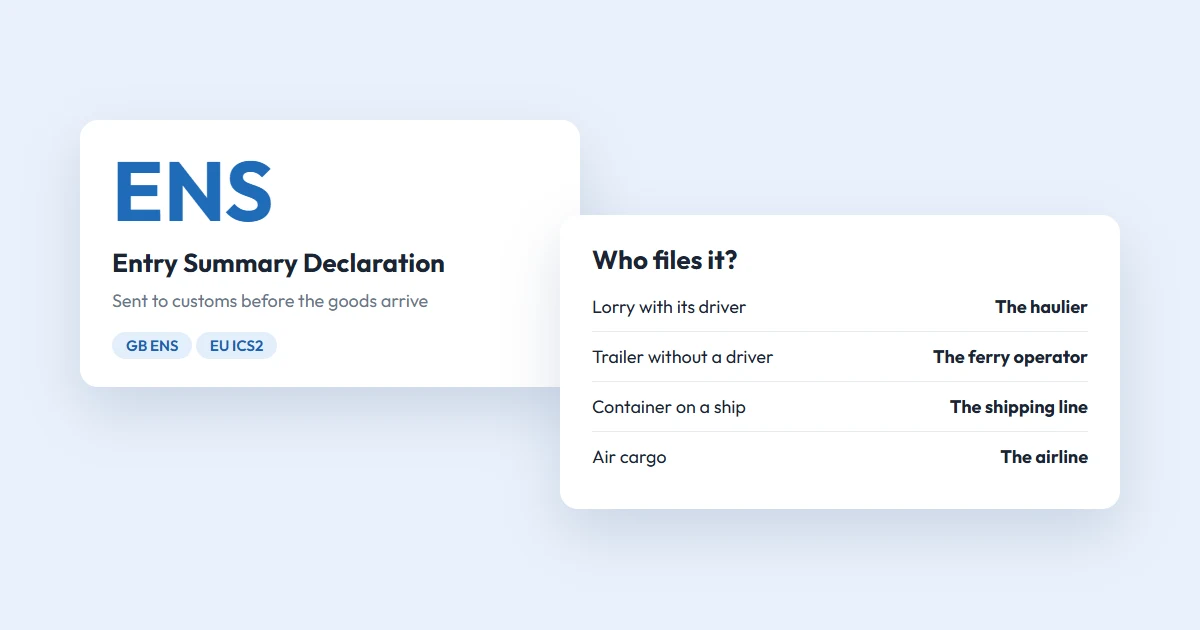
"ENS" turns up on freight quotes, on shipping line invoices and in emails from the ferry company asking for an MRN before the lorry can travel. It stands for Entry Summary Declaration.
An ENS tells customs what is about to arrive: who sent it, who it's for, what it is, how much it weighs and how it's travelling. Customs uses it to decide, before the goods land, whether anything needs a closer look. HMRC says it helps the "fight against illicit goods such as illegal drugs and weapons".
It isn't the import declaration
People mix the two up, because much of the data is the same.
| Import declaration | ENS | |
|---|---|---|
| What it's for | Duty and tax | Safety and security |
| Who files it | Usually the importer or their agent | The carrier |
| When | Around arrival | Before arrival, by a fixed deadline |
| What you get | Customs clearance | An MRN (movement reference number) |
So a load can be fully cleared for import and still be missing its ENS. They're two separate jobs, often done by two different companies.
One name, two systems
Great Britain and the EU each run their own:
- Great Britain: S&S GB (Safety and Security GB), run by HMRC. An ENS has been needed for goods from the EU since 31 January 2025. We call this one a GB ENS.
- The EU: ICS2 (Import Control System 2). Road and rail joined on 1 April 2025. The European Commission says that from 1 June 2026, all consignments entering the EU "by any means of transport" should have a valid ENS.
Northern Ireland uses ICS2, not S&S GB.
A lorry going from Calais to Dover needs a GB ENS. The same lorry coming back loaded needs an ICS2 ENS. A round trip is two filings in two systems.
Who has to file it?
The carrier. HMRC's guidance says: "The legal requirement to submit entry summary declarations, within the specified time limits, lies with the carrier." Who counts as the carrier depends on how the goods travel:
| How the goods travel | Who is responsible |
|---|---|
| Lorry with its driver, on a ferry | The haulage company |
| Lorry through the Channel Tunnel | The haulage company |
| Trailer without a driver, on a ferry | The ferry operator |
| Container on a ship | The shipping company |
| Air cargo | The airline |
| Rail freight | The rail freight operator |
The EU's rule is the same in outline. Its guidance says the declaration "shall be lodged by the carrier", and for a lorry on a ferry "the road haulier operating the truck" is that carrier.
Someone else can file for the carrier: a forwarder, a customs agent, or software like ours. For Great Britain that needs "the carrier's knowledge and consent", and the legal responsibility stays with the carrier. More on that in Whose responsibility is it to submit an S&S GB declaration?
What about containers?
For sea freight, the shipping line files for the bill of lading it issued. Under ICS2 a freight forwarder with its own house bills either files that house-level data itself or passes it to the line to file. That's where the "ENS fee" on a shipping line's invoice comes from.
By when?
Each mode has its own deadline. These are the minimums.
| How the goods travel | Into Great Britain | Into the EU |
|---|---|---|
| Lorry or trailer on a ferry | 2 hours before arrival | 2 hours before arrival at the first EU port |
| Lorry through the Channel Tunnel | 1 hour before arrival at the terminal in Coquelles | 1 hour before arrival |
| Lorry across a land border | n/a | 1 hour before arrival |
| Container on a deep-sea ship | 24 hours before loading | 24 hours before loading |
| Bulk cargo by sea | 4 hours before arrival | 4 hours before arrival |
| Air, flights under 4 hours | By take-off | By take-off |
| Air, flights of 4 hours or more | 4 hours before arrival | 4 hours before arrival |
For ICS2, a lorry on a ferry follows the ferry's 2-hour limit. The 1-hour road limit is for lorries that drive across a land border, for example from Turkey into Bulgaria.
In Great Britain you can file up to 200 days ahead, so there's no need to cut it fine.
What's in an ENS?
For a GB ENS, HMRC asks for 20 mandatory fields. The main ones:
- the consignor and the consignee;
- a description of the goods in plain English, the kind and number of packages, and the gross weight;
- the vehicle or vessel, the route, and the port and time of arrival;
- where the goods were loaded and where they'll be unloaded.
ICS2 asks for more: a 6-digit commodity code for commercial goods, and the buyer and seller as well as the sender and receiver.
Both want a real description. "Parts" or "general cargo" won't do. See what counts as a valid goods description.
When you don't need one
A few of the exemptions that matter on the road:
- Empty trailers, containers and packaging, as long as they aren't moving under a transport contract. See Do you need an ENS for an empty vehicle?
- Travellers' personal luggage.
- Goods under an ATA carnet, again only when they aren't carried under a transport contract. A person driving their own exhibition goods in their own van is the usual example.
- Letters and printed matter. Parcels are different: the EU wants an ENS for postal items that contain goods.
What happens without one?
In Great Britain the maximum penalty is £1,000 for the carrier, under the Customs Safety and Security (Penalty) Regulations 2019. HMRC says enforcement can also mean "goods being delayed at the border for further checks".
In the EU, penalties are set by each country. The Commission's warning is simpler: "Goods might be stopped at the EU borders." For crossings to France, the ICS2 ENS is also needed for the ELO, the French port pass, so without it the lorry may not board at all.
How do you actually file one?
Not on a government website. GOV.UK says: "The Safety and Security GB (S&S GB) and ICS2 services do not have user interfaces." You need software that talks to them, or someone who has it.
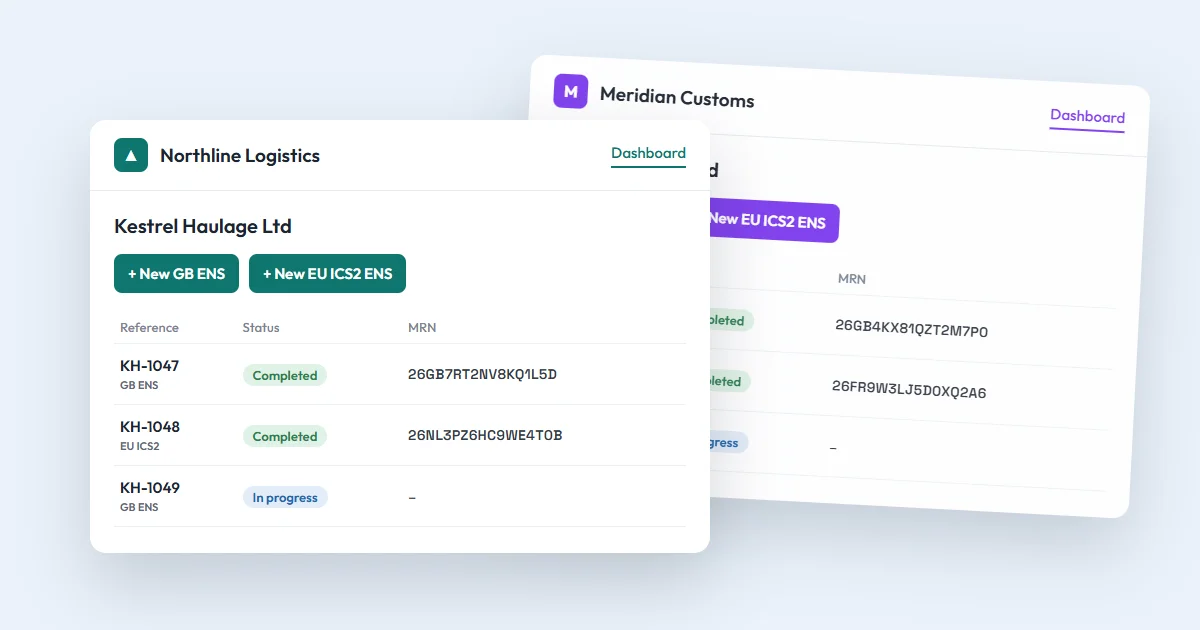
That's what ENS Ready is: one account for both GB ENS and ICS2. You fill in a form, we send it to HMRC or to the EU, and the MRN arrives on your dashboard and by email. It costs from £0.75 to £4.50 per ENS, with no subscription. Create a free account and file your first one today.
Questions
What does ENS stand for in shipping?
Entry Summary Declaration. It's a safety and security declaration sent to customs before goods arrive, so they can be risk assessed. HMRC also calls it a safety and security declaration.
Who has to file the ENS?
The carrier. For a lorry with its driver on a ferry that's the haulage company, for an unaccompanied trailer the ferry operator, for a container the shipping line and for air cargo the airline.
Is an ENS the same as an import declaration?
No. The import declaration is for duty and tax and is usually made by the importer. The ENS is for security, is filed by the carrier, and has to arrive before the goods do.
How long before arrival must an ENS be filed?
For a lorry on a ferry, at least 2 hours before arrival, into Great Britain or the EU. Through the Channel Tunnel into Great Britain it's 1 hour. Containers on deep-sea ships need it 24 hours before loading.