With a lorry, the question of who files the ENS has a short answer: the haulier. At sea there are more companies between the sender and the ship, and the answer depends on what kind of cargo it is and where it's going.
Three kinds of sea freight, three answers
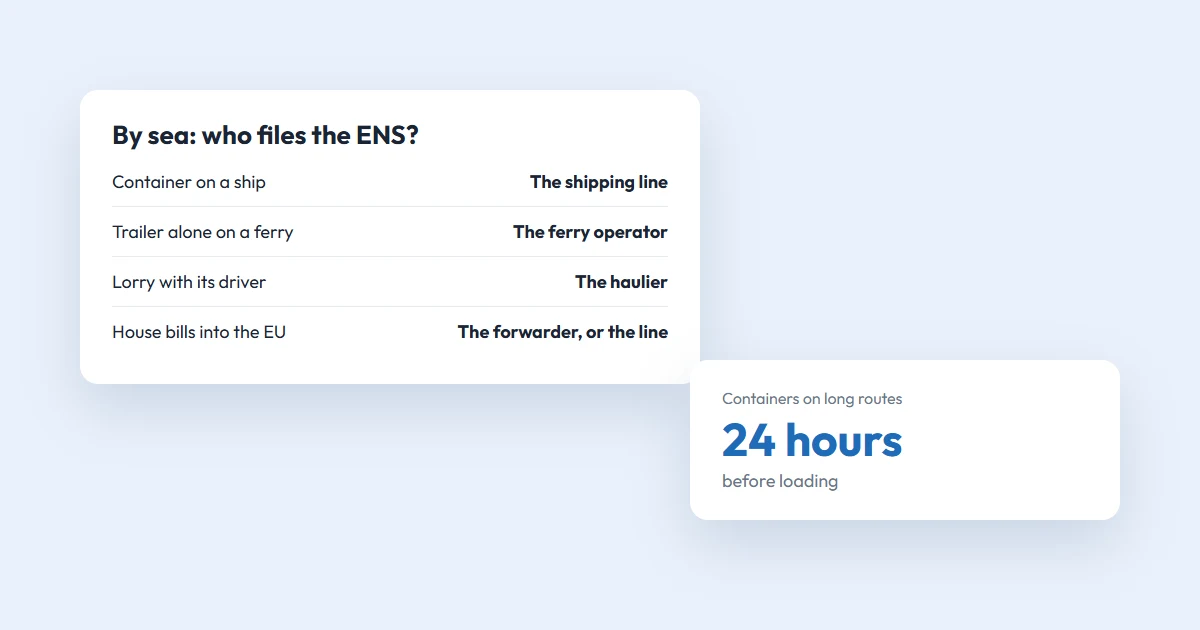
GOV.UK's guidance puts the duty on the carrier, "the operator of the active means of transport". For goods arriving in Great Britain by sea that gives:
| The cargo | Who is responsible for the ENS |
|---|---|
| A container on a ship | The shipping company |
| A trailer on a ferry without its driver | The ferry operator |
| A lorry on a ferry with its driver | The haulage company |
For containers, the carrier is the company that issued the bill of lading.
Someone else can file for the carrier, but only "with the carrier's knowledge and consent". The legal responsibility doesn't move: it "still remains with the carrier".
The deadlines into Great Britain
| Sea freight | Deadline |
|---|---|
| Containers on long sea routes | 24 hours before loading at the port of departure |
| Bulk and break bulk | 4 hours before arrival |
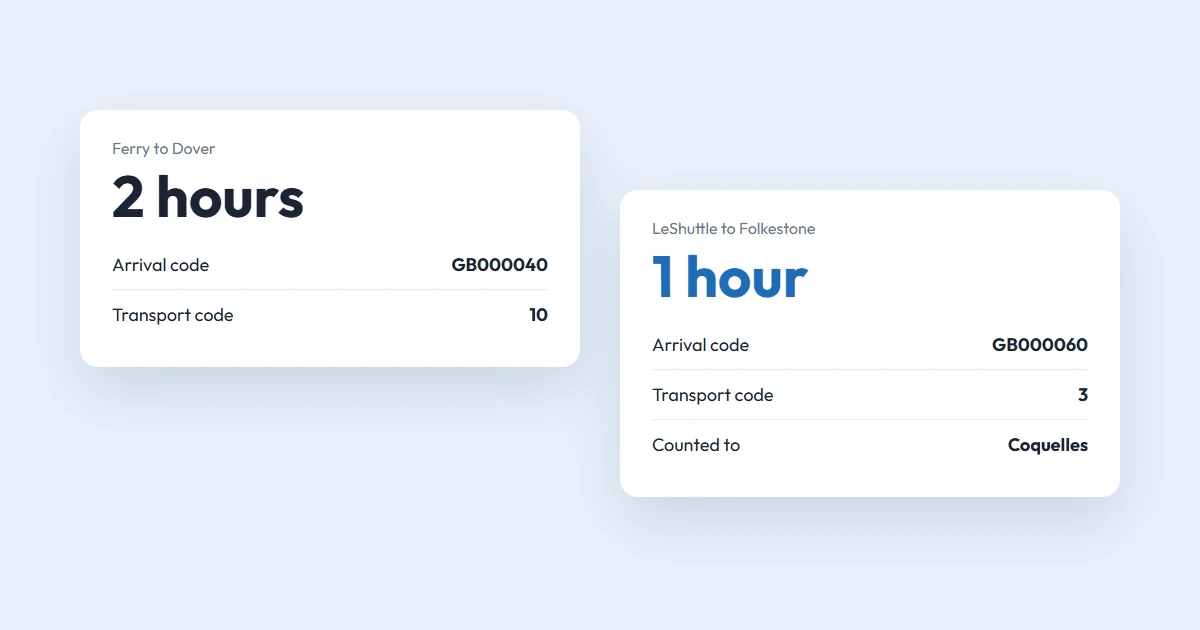
| Short sea, containers or not | 2 hours before arrival |
| RoRo ferry, with or without a driver | 2 hours before arrival |
The 24-hour rule is counted from loading, not arrival. A container booked too late for it has to wait: GOV.UK says the carrier "must look to load onto a later vessel".
Short sea, for Great Britain, means a voyage from the Channel or the Atlantic coast of Europe as far south as Algeciras, from Norway, Ireland, the Faroe Islands or Iceland, or from a port on the Baltic or the North Sea. A container from Rotterdam or Bilbao has the 2-hour limit. One from Genoa or Istanbul doesn't.
In the EU, the forwarder now has a job too
ICS2 started for sea freight on 3 June 2024, and it changed who has to do what. A shipping line knows what its own bill of lading says: often just the forwarder's name and "consolidated cargo". The real senders and receivers are on the forwarder's house bills, which the line never sees.
The EU wants that house-level detail. The European Commission's ICS2 questions and answers describe two ways to provide it:
- the forwarder gives its house bill data to the shipping line, which files everything; or
- the forwarder files its own part straight into ICS2. The Commission calls this multiple filing, and the forwarder a "house level filer".
The deadlines are the familiar ones: 24 hours before loading for containers on long routes, 4 hours before arrival for bulk.
If customs see a risk, the answer can come before the ship leaves. The strongest one is "Do Not Load".
What the shipping lines charge
When the line files the house bills for a forwarder, it charges for it. These figures are from the lines' own notices:
- MSC, December 2024: USD 30 per house bill of lading.
- Hapag-Lloyd, March 2025: USD 35 per house bill of lading.
- Maersk, November 2024: USD 120 per house bill of lading.
They're also strict about the data. Maersk announced a "No MRN, No Load" policy from 30 September 2026. The lines ask for a six-digit commodity code, the EORI of a consignee in the EU, and a description that says what the goods are. Maersk's examples of words that won't do include "Accessories", "Apparel" and "Auto".
These notices are one to two years old. Ask your line for today's tariff.
Northern Ireland follows the EU system
HMRC's service can't be used for a first arrival at a Northern Ireland port. Goods arriving there from Great Britain or from outside the EU need an ICS2 ENS.
What a GB ENS for a ship contains
On top of the usual senders, receivers and goods, HMRC asks for:
- the ship's IMO number;
- the voyage number;
- the container numbers, where there are containers;
- the port of loading and the first port of arrival in Great Britain, as a location code. Felixstowe is GB000051, Southampton GB000290 and London Gateway GB000170.
The transport code is 1, maritime. Codes 10 and 11 are for RoRo ferries.
Where ENS Ready fits
We file two things for sea freight, and it's fair to say what we don't.
GB ENS for a ship. Choose Ship (LoLo) on the GB ENS form. It asks for the port of loading, the UK port of arrival, the IMO number, the voyage number, and whether the cargo is containers or bulk. Container numbers are checked as you type, so a mistyped digit is caught before HMRC sees it. If you're a shipping line, a ship's agent, or a forwarder filing with the line's consent, that's the form for you.
Lorries on ferries. GB ENS for arrivals in Great Britain and ICS2 for arrivals in the EU, which is what most of our customers file every day.
Not yet: ICS2 for containers. For house bills going into the EU, you'll need the shipping line or a house-level filing service.
An ENS costs from £0.75 to £4.50 with no subscription. Create a free account, or read what ENS means in shipping first.
Questions
Who files the ENS for a container?
The shipping company. GOV.UK says that for sea the shipping company is responsible. In the EU's ICS2, a forwarder with its own house bills files that data itself or gives it to the line.
How long before sailing must a container ENS be filed?
For containers on long sea routes, 24 hours before loading at the port of departure. On short-sea routes into Great Britain it's 2 hours before arrival, and for bulk cargo 4 hours before arrival.
What do shipping lines charge to file ICS2 house bills?
Published notices show USD 30 per house bill of lading at MSC, USD 35 at Hapag-Lloyd and USD 120 at Maersk. Check the line's current tariff before relying on a figure.
Can a third party file the ENS for the shipping line?
Yes, for Great Britain, with the carrier's knowledge and consent. The legal responsibility stays with the carrier.